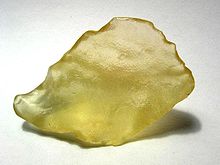
Libyan Desert glass or Great Sand Sea glass is an impactite, made mostly of lechatelierite,[1] found in areas in the eastern Sahara, in the deserts of eastern Libya and western Egypt. Fragments of desert glass can be found over areas of tens of square kilometers.
Geologic origin

The origin of desert glass is uncertain. Meteoritic origins have long been considered possible, and recent research links the glass to impact features, such as zircon-breakdown, vaporized quartz and meteoritic metals, and to an impact crater.[2][3][4][5][6][7][8] Some geologists[9] associate the glass with radiative melting from meteoric large aerial bursts, making it analogous to trinitite created from sand exposed to the thermal radiation of a nuclear explosion. Libyan Desert glass has been dated as having formed about 29 million years ago.[10] Like obsidian, it was knapped[citation needed] and used to make tools during the Pleistocene.
| This article uses material from the Wikipedia article Metasyntactic variable, which is released under the Creative Commons Attribution-ShareAlike 3.0 Unported License. |